

Week two of our van tour
Monday – Pontevedra and Galicia coast


We woke up early and drove North into Spain to meet Israel and Katie (friends from NZ) who would be joining us for the remainder of the van tour. Turns out we were an hour late because we forgot to check the time difference between Portugal and Spain. Despite being late we managed to find each other and squeeze into the van together. The van technically had enough space for 4 people to sleep (two roll-out queen beds) but it was very small and we were curious to see how we could all squeeze in. After co-ordinating a grocery shop for our joint meals, we headed off to find a beach and some surf.
Just like in Portugal, Northern Spain has beaches that are carved out of the cliffs by the strong Atlantic ocean and share the same cold temperature that come with it. We found a beach with big surf and threw Izzy and Katie into the frigid waters. Unfortunately, there were no board rentals available at there, so we settled on playing in the surf. It was a very steep beach and the waves were rearing up and breaking only a couple off meters off the shore, which was good fun as you could run and dive into the face of the waves from the sand.
We drove a little further and ended up at our campsite for the night, a small clifftop carpark in a deserted coastal area. We were the only people here and devoured a classic NZ spaghetti Bolognese while the sunset directly in front of us.
Tuesday – Coste da Morte


The following day we woke up to drizzle, which progressively turned into a torrential downpour. During our 25 days in Portugal we had only had a ½ day of rain, so we hadn’t even thought of looking at the weather forecast before deciding on our route through Spain. If we had done so, then we would have seen that by driving east on the first day we could have avoided the rain altogether! Too late, because we had already started our journey towards the western ‘Costa da Morte’.
The Costa da Morte, literally translated to death coast, is a section of coastline in Galicia Spain that was named because of the dangerous combinations of waves, currents, cliffs and winds that have resulted in a huge amount of shipwrecks and deaths over time. According to our research, the Costa da Morte was meant to be a dangerous, but a beautiful rough and remote stretch of coastline with many imposing lighthouses on towering cliffs (and a bonus was not many tourists come out this far).
The further we drove into Costa da Morte, the worse the weather got… Soon I could barely see 20m outside of the van while I was driving because of the mist and rain. We arrived at ‘Faro de Fisterra’ lighthouse which is perched on a peninsula and is meant to have amazing views of the rugged coastline. Yet when we arrived, we couldn’t even see the bottom of the cliffs, let alone the ocean. Despite the lack of views, the thick fog made for an eerie and beautiful atmosphere.
Since there were no views from up high, we decided to change tact and head down to the beaches themselves and potentially embrace the weather with a little dip in the ocean.
We turned up at Playa de Rostro and were immediately greeted by a huge sign stating NO SWIMMING! According to the sign, this rule is in place 365 days per year because of unseen strong currents that make swimming extremely dangerous and have already resulted in a lot of deaths. Even with the heavy rain and fog, the ocean was glassy and looked very enticing! I can see how many a naïve person would have jumped straight into the water without a second thought, but having seen the many warning signs, we managed to hold ourselves back, just… We went for a nice walk along the beach, explored the rockpools and limited ourselves to some ankle-deep wading in the ocean. It was quite reminiscent of Farewell Spit, in the South Island of NZ, which we also visited in similar misty cold weather.
Not to be denied our daily swim, we headed for Nemina beach. We were recommended this beach by some Spanish friends and heard that it has great surfing potential. Unknown to us, the route to Nemina beach is a mixture of narrow windy village streets and off-road 4×4 tracks. We tried our best to get there but ended up completely stuck in the middle of nowhere. To get our big van back out of the narrow streets I had to do a 5 point turn on a steep hill with handbrake starts, using Izzy as guidance, with village walls all around. I managed to manoeuvre out without damaging the van which was a miracle. So we had no choice but to give up on Nemina beach and hightailed it out of there. I presume all the people who raved about this beach had smaller more manoeuvrable cars to get through the streets, or there was an easier road there that we entirely missed…
Our last stop for the day was a campervan parking spot which, according to Park4night, had free power. So we headed there with the hope of plugging in our laptops and watching movies while we waited out the rain. Sadly it was a case of false advertising; there was no power, also no hot showers and instead there were signs banning campervans… With broken Spanish we managed to confirm with a council worker that we could stay the night regardless, and instead of movies we had a big dinner and a few drinks while teaching Katie how to play 500.
Wednesday – Drive to Asturias


We checked the weather forecast and saw the rain cleared further east, so we made the executive decision to skip the rest of our Costa da Morte itinerary and drive as far east as we needed to reach the sun!
So the next 6 ½ hours were spent in the van chasing the sun towards Asturias!
Later that afternoon we arrived at Xago beach and emerged from the van into glorious sunlight. The beach had great surf but sadly no board hire =( After more than 6 hours in the car we weren’t complaining and jumped straight into the icy cold water to shock ourselves awake. We relaxed for a few hours in the sun before it started drizzling and we were forced back into the van to drive the last stretch to our overnight spot.
We discovered just in time that ‘freedom camping’/’overnight campervan parking’ is illegal in the province of Asturias and you can get a hefty fine… This has forced campers to find private landowners who are willing to have people stay, often on farms. Luckily there were plenty of private campsites to choose from and the place we discovered was AWESOME. For only 2 euro we could park anywhere we wanted on a huge flat meadow at the top of high cliffs. There was even a little café/bar on the farm and a semi-private beach at the bottom of the cliffs. We parked directly alongside the edge of the cliff which meant we had epic ocean views from our bed, as well as a slight risk of stepping of the cliff edge when going outside at night…
We wandered down to the beach and saw there were some clean small waves rolling in and heaps of surfers. Unfortunately, again, there was nowhere to rent surfboards. If this was Portugal, there would be 2-3 popup shops renting boards at every surf spot… So we settled for watching other people surf and had a swim before heading to the bar which was conveniently located right next to our van. Asturias is famous for its locally brewed ‘cidre’ (cider). We sampled a few bottles and were happily surprised to discover the 6% Asturias cider comes in 1L bottles! We also ordered some burgers (they even had gluten free options) but just as we started eating the torrential rain rolled in and it was back into the van with the lot of us.
We took our burgers, crammed back into our now dewy smelling van and settled in for another evening of 500 (card game).
Thursday – Beach tour of Asturias


After yet one more night of rain, we woke up to a sunny day, woohoo! To celebrate the good weather we ran straight to the beach and dove into the water. It quite unique with clear blue water and a sandy beach so steep that within a couple of steps into the water it was overhead. This meant we could pretty much dive from the sand headfirst into the water, like diving into a pool.
Asturias is most notorious for its beautiful coastline and beaches, so we decided to dedicate this sunny day to beach hopping. We chose 5 spots to visit then jumped in the van and started exploring the northern Spanish coastline.
Playa de Greiga:
This was our first intended stop for the day. This white sandy beach lies at an estuary mouth and the beach is neighboured by forest. It also draws a lot of crowds because of the dinosaur footprint in the rocks nearby and there is a Jurassic Museum just back from the beach where some fossils were found. We were excited to explore this beach and see the dinosaur footprint, but it turns out every person had the same idea. After ½ an hour of trying to find parking, and more multi-point handbrake turns in narrow streets, we gave up and carried on to the next beach.
Playa de Nueva:


This beach is known for its many caves and the rock climbing that can be done directly alongside the beach and ocean. The beach was packed with sunbathers, swimmers and climbers. There are heaps of climbing routes from easy to difficult and it’s awesome that people can come and climb here for free (provided you have your own gear and can lead climb). I was a little bit gutted that I couldn’t hire any gear to have a go. I watched the climbers for a while then went for another swim. At low tide the water here stays shallow for a long time and is full of seaweed until you swim out of the inlet past the crowds and weirdly warm water to deeper clear water. Time flew by so before we knew, it was time to head to our next destination.
Playa Gulpiyuri:


Ironically, our next beach stop Playa de Gulpiyuri, was not actually next to the ocean, nor could we even see the ocean from this little circle of sand. This unique beach is formed by a flooded sinkhole located about 60m from the ocean. The beach is fed by a 40m network of underground tunnels which have been carved out by the Cantabrian sea. It is tidal fed so at high tide a nice swimming pool forms in front of the tunnel mouth. However we visited at low tide and the water had receded all the way back to the tunnel. It was a unique place to see and we would have explored the rock tunnel if we had thought to bring shoes down with us. Instead we sat for a while and laughed at the other tourists who were trying to climb into the tunnel with jandals while the swell from the sea was washing through it.
Playa de Poo:


Literally translated as ‘poo beach’. This was a very quick stop after discovering that the beach was shit, hence its very appropriate name. It had a wide expanse of brown mud flats leading to a shallow beach with brown looking water. The beach is in an inlet and you can’t even see out to the open ocean… I guess we shouldn’t have been surprised given the name of the beach. I was confused by the amount of people still sunbathing and swimming at this beach given how many better beaches were nearby!
Playa de Berellin:


Our last stop for the evening was Playa de Berellin. This beach is next to a private farm that also offered overnight parking for our campervan. It was one of the most beautiful beaches we had seen in Spain. With a view of steep sloping grasslands down to the twin beaches, pretty rock formations and spectacular bay, it was a great place to park up. We finished our beach day with a dinner, wines and an epic sunset. It was such a hot night that later that evening, fueled by some moonshine port, we ran down the winding road to the beach to cool off. While swimming we could hear the crashing waves from the open ocean echoing into the bay and we were even blessed by phosphorescence which made our skin glow with sparkling lights as we swam.
Friday – Picos de Europa


Today was our day to explore the mountains just inland of the coast, Los Picos de Europa. And guess what; we woke up to more rain!! So our carefully laid plan to walk the famous Cares route went out the window given the mountains appeared to be completely shrouded in rain clouds.
Playa de Pechon:


To give the rain a chance to clear, we went to a beach we had missed the day before. Playa de Pechon is at the base of some beautiful forested hills that merge straight into an estuary. Much like a very small version of Fjiordland in NZ. It was well worth the visit even in the gloomy weather. There were many signs forbidding swimming and warnings of strong estuary currents. Given how caked in sweat we were after the muggy heat of the previous night, we did it anyway (and survived to tell the tale).
Cicera:


The rain still hadn’t cleared so instead of walking the Cares route, we decided to drive into the edge of the mountain range to a small highland town Cicera to get a taste of the Picos de Europa. As we drove into the mountains, the rain gradually cleared, lucky us! We arrived at Cicera and soaked up some brief rays of sunshine while enjoying another Asturian cider at the local pub. We walked the cobblestone streets and explored this tiny historic mountain village then started a short hike to the top of a nearby lookout.
Santa Catalina Lookout:


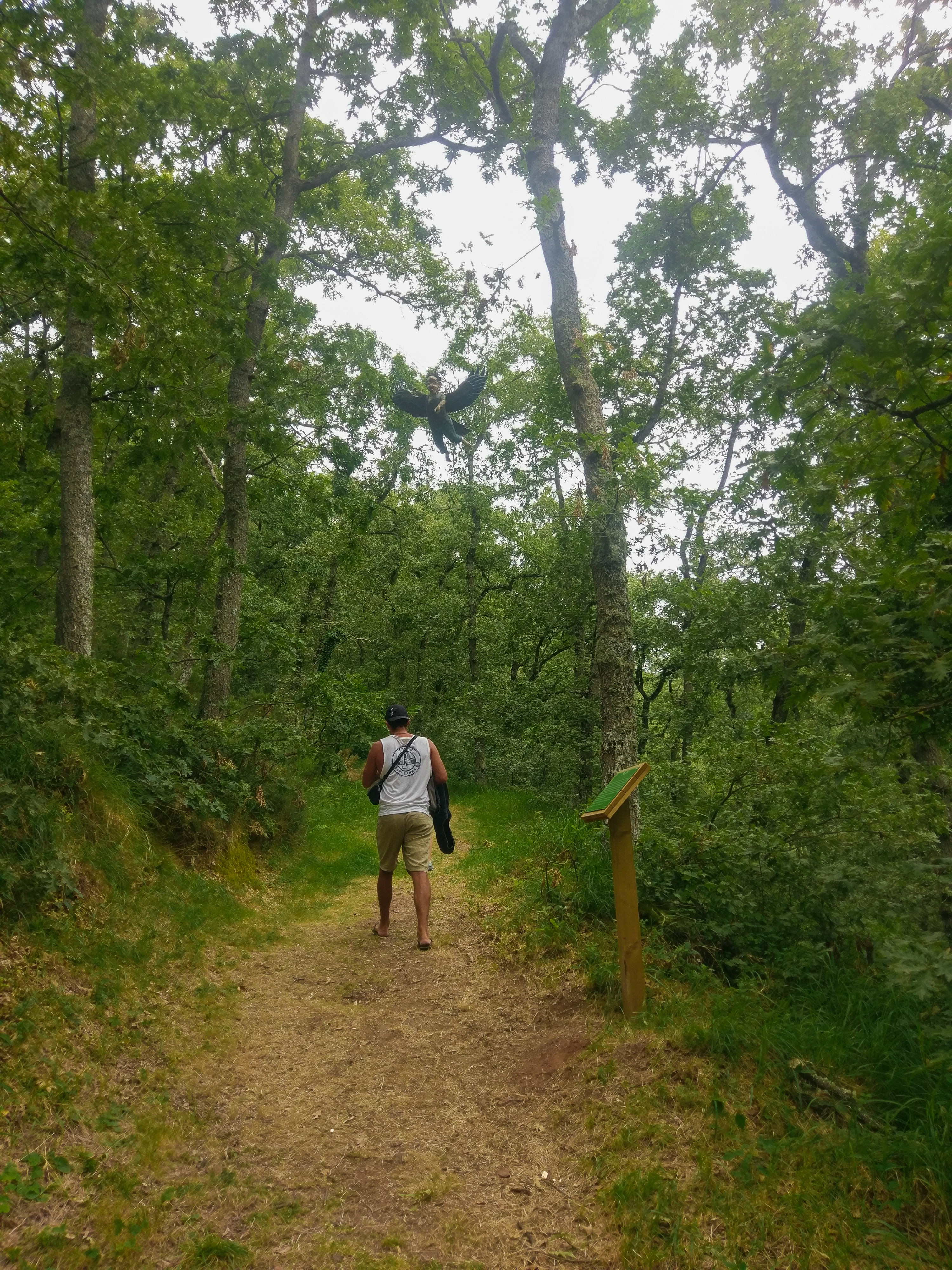


The walk through the forest was scattered with mythical creature statues hidden throughout the trees which seemed to part of some kind of local Spanish folk tale. It kept us entertained taking pictures and trying to interpret the signs while we trudged up the steep incline. It was well worth the climb when we reached the lookout, with its jaw dropping panoramic views across the surrounding mountains.
We headed back down the mountain into the rain and spent our last night in the van back at Playa de Berellin.
Saturday – Into Bilbao
We had a lazy morning then set off for the final 2-hour drive to Bilbao where we had to say goodbye to our campervan. It was great fun exploring Portugal and Spain by van. Being able to drive wherever we wanted, explore small off-the-beaten-track towns and sleep alongside many beaches and dunes. However we were also looking forward to a hot shower and some extra space after living in each other armpits for a week =P
We caught the train into Bilbao and walked to our BnB which was located right in the center of the old town. The BnB owners did not speak any English and despite having called and attempted to explain we were outside the door in broken Spanish, it took almost an hour until the elderly Spanish couple emerged and let us in. The house was very old (apparently a historic building) and each of our rooms had a small balcony that looked out over the main street and into the town square. We could even hear a busker playing violin and a clown making balloon animals from inside our room. We spent the evening wondering around the old town, past various buildings and found a gluten free Pixtos bar for dinner. Pixtos are the Basque version of tapas; small pieces of baguette with a multitude of tastefully selected toppings. Hardly a big kiwi dinner, but surprisingly delicious.
Sunday – Bilbao


Sunday was the first day in two weeks we didn’t have to drive anywhere, and it was great! Since our BnB was in the very centre of the old Bilbao town, most of the nice sights were within 10minutes walk of our place.
Unfortunately, we forgot that many of the shops and supermarkets are closed on Sunday and all the gluten free places we had scoped out for breakfast the night before were closed. We ended up having to wait until 1pm for a gluten free pizza joint to open and ate a very late brunch there.
With big food babies we then wandered along the river to the Guggenheim Museum. This modern and contemporary art museum was designed by the architect Frank Gehry and is an example of 20th century architecture style known as ‘deconstructionism’. This is a modern architecture style in which the building looks like a bunch of randomly placed surfaces and twisted lines and curves that give the impression the building could collapse at any time.
The Guggenheim was opened in 1997 and is one of the most important modern art museums in the world, home to works from Salvador Dali, Picasso and Andy Warhol. As a result, after two weeks of near solitude in the van, we were thrown back into the tourist crowds at this number 1 attraction of Bilbao. The giant museum actually looks like a sculpture itself, and there are more works of art scattered around the outside including a huge metal spider. We admired the crazy architecture and art on the outside of the Guggenheim (Marlous was outvoted because no-one else wanted to wait in the entrance line for hours) then ventured across the river to ride the funicular to the top of a viewpoint. We had an amazing view of the whole town from up here with the river snaking through and its striking red tiled buildings nestled among the green hills.
The previous night we had gone for dinner far too early and many pixtos bars were still closed. So having discovered that the Spanish eat late, this time we didn’t venture out for dinner until 10pm. Regrettably, we shot ourselves in the foot because it seems that 10pm is TOO late. Most of the food was gone and we were left with old, stale and unappealing food choices. So we resorted to a kiwi classic; hot chip takeaways. Granted they are called patatas bravas in Spain and are triple the price, but they still went down a treat.
This was out last night in Spain and it is a place (along with Portugal) we will be going back to explore more in the future.
Monday – Into France


We were up at 6am and marching to the bus station (40min away) to jump on our nine-hour bus to Tours. Here we would be meeting some other Kiwis from NZ and embarking on a 6-day bike ride through the Loire valley.
Nine hours is the longest we have ever spent in a bus, but it went by surprisingly quick. It did not go so quick for Katie and Izzie who both suffer from carsickness and could not read or use their laptop like us… Thankfully the bus made lots of stops so we could have toilet breaks and buy overpriced food from the petrol stations.
We arrived in Tours late Monday evening and met up with the 5th member of our biking group, Rebekah!
Here we come Loire Valley, a rowdy NZ crew and cheap wine !
 Sean and Marlous travel diaries
Great read, really enjoyed it!!!
LikeLike